Apply Discount Code
Bicycle Union Issue 7 Reality Filter
£29.99
SKU
MIBI16
Here comes Bicycle Union Issue 7 - Reality Filter, with all the usual bluster we give. This one is a little more than just a magazine though, and it comes with a 7" vinyl record recorded by the magazine makers... Read More.....
Ready for Dispatch
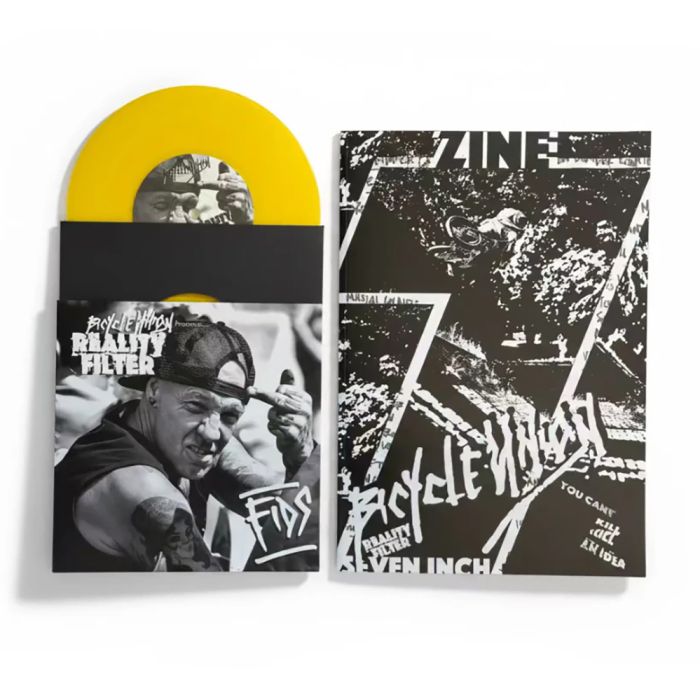
Here comes Bicycle Union Issue 7 - Reality Filter, with all the usual bluster we give. This one is a little more than just a magazine though, and it comes with a 7" vinyl record recorded by the magazine makers.
Let me give you the not so long winded information. Music has always been an integral part of BMX to us, we wanted to do something on BMX riders who play music in this issue, and to find out the experience of actually making some music our selves…
Inspired after watching Eddie Roman in Ride like a man make his own songs to a couple of sections from said video I instantly thought, we need to do something like this.
We went into rehearsal rooms every week for 1 year, at the end of that year went into a recording studio and came out with 3 of our own ‘metal’ songs… which are the songs on the record. Theres a QR code for download inside as we know most people have no record player. Our journey into this project is covered with in the magazine.
Track listing for vinyl:
- Fids
- Enter the chalice
- Think tank
Musical BMX interviews with:
- Sandy Carson of Road fools and now the band ‘Skloss’.
- Tom Blyth ex FBM pro, now vocalist in ‘Blind Monarch’.
- Alex Leech Oxford BMX legend inventor of the LHD wheel and Guitar player in ‘Tenth listen’.
Some of the other magazine features are Stew Johnson interview on filming the UK S&M guys London trip.
The origins of Vert riding, where did it grow its legs and who were the originators….with input from Jamie Bestwick, Jon Taylor, Zach Shaw, Simon Tabron, Paul Meacher.
Rooftop’s bash guard practises and the return of something most thought was extinct!
Ron Kimler why cant I quit.
Basildon Bowl and 2 toothpicks.
Home grown street enthusiasts, Sunny blunts interview with Tim Evans about their new DVD and Zine release.
Broad marsh banks retrospective by Neil Waddington, one of the best UK street spots most never got to ride.
Ben Bomber Counter digs deep about BMX, bomb drops and the BB Buddy’s.
Davey Wall is ‘mad for it our kid’ Manchester’s angry raving flow man spills the beans.
Michael O’Connell lets rips about the often over complications of trick riding and getting a good nights sleep.
BMX philosophers.
Web slinging.
BMX pics from around the world.
Random rants, wind ups and insults…. as well as all the other stuff…"
- Lead Time: 0
Write Your Own Review
Only registered users can write reviews. Please Sign in or create an account
People also bought



New Rider?
FREESTYLE VS RACING BMX BIKES?
Choosing the correct bike for your discipline is extremely important, and sometimes for those new to the sport it can be difficult to know or decide, so we’ve broken down the main differences to help you make a decision.
Freestyle bikes are designed for the skatepark, the streets or the trails. They are constructed from strong, hard wearing materials and usually feature Steel or Chromoly frames. This means that the bike can stand up to a certain amount of impacts and hard landings, but remember no bike is indestructible. For riders looking to learn tricks and stunts, then a freestyle bike is the correct choice.
Race bikes are designed specifically with the track in mind, they are nimble lightweight machines for putting down quick lap times. Typically, they are constructed from lightweight materials like aluminium and carbon fibre to keep the weight down and the rider at the front of the pack. These bikes are strong enough for smooth landings on race and pump tracks but will not take the abuse that a freestyle bike would in concrete skateparks. If you’re looking to set fast lap times or begin your competitive career on the track, a race bike is the right choice.
WHAT SIZE BIKE WOULD I NEED?
Choosing the correct size BMX bike is very important, bikes that are too large will be cumbersome and hard to manoeuvre and bikes that are too small can feel cramped and hard to keep under control.
Youth freestyle bikes are sized depending on the diameter of the wheel staring at 12” all the way through to 18”, at a 20” wheel the bike is considered an adult size. Adult freestyle bikes are sized on top tube length, a 18.5” top tube is extra small for younger teenagers who have just moved up to an adult bike, a 20” top tube is small, 20.5” a medium and anything over a 21” is considered large.
Race bikes feature 20-inch wheels on all models, but the components and frame are sized dependent on age and height. Youth race bikes start from a Micro size for very young riders and offer a range of sizes through to expert XL. Pro size and upwards are considered adult bikes and are usually offered up to a Pro XXXL or larger for very tall riders.
We recommend consulting our height charts from the link below to help you choose your perfect sized bike:
WHAT LEVEL DO I NEED?
Choosing the right level bike for your riding ability is important. Components that are not suitable for your level of riding can wear or fail much sooner than expected. Although BMX bikes can look very similar, under the surface components and materials used can vary greatly.
All our bikes are cherry picked from the very best BMX specialist brands, and all our bikes are designed specifically for use at the skatepark or on the track.
FREESTYLE BIKES
For first time riders new to the sport our entry level bikes, priced from £200-£400, are perfect, most of these are made from high tensile steel which means they are still relatively strong, but can be slightly heavier than higher end models. You might find you’ll want to upgrade to something lighter sooner than you’d think. If you are planning on using the bike in rain or bad weather, we do strongly advise choosing a model with fully sealed bearings all round.
If you are already confident on a bike and have some experience in skateparks or performing tricks and jumps then we would recommend choosing a mid-range bike, priced from £400 to £700, with a full Chromoly frame, fork, and bars. This will be lighter and stronger than an entry level model.
For an experienced person that is already capable of performing most tricks and has previously owned BMX bikes then a high-end complete bike, or full custom would be suggested to meet the demands of this rider, these bikes are priced from £700 plus.
RACE BIKES
Our range of entry level race bikes are perfect for first time racers, usually priced between £200 and £400 most of these are constructed of heavier steel rather than aluminium. These are great to get a feel for the sport but would not be able to keep up in a competitive environment.
Our mid-range race bikes are the perfect for riders who are beginning their path to competitive racing. Priced between £400 and £800 these are not quite the high-end steeds you see at national level races, but they all feature lightweight aluminium frames and are designed specifically with the racetrack in mind.
For experienced riders who are already racing confidently at a competitive level we offer a small range of high-end complete bikes. These are usually priced between £800 and £1500 and feature many aftermarket components like carbon forks, disc brakes and folding tyres. However, at this level we highly recommend building a full custom bike, usually costing between £1500 and £3000 all components can be chosen specifically with the rider in mind. For help on building a custom bike give us a call or drop us an email!
CASSETTE OR FREECOASTER
One of our most frequently asked questions in freestyle is, which rear hub do I want, a freecoaster or a cassette? Most experienced riders know their preference, but if you’re new to the sport it can be difficult to know which choice to make.
The main difference between the two is the way the bike performs when going backwards. A traditional cassette hub requires the rider to pedal in time with the rotation of the wheel while travelling backwards, while a freecoaster allows the rider to travel backwards while keeping the pedals level in the same position as riding forwards.
Although this may seem like a brilliant feature, it does come at a price! Freecoaster hubs feature a “Slack” before engagement while pedalling forward. This means that you can turn the crank a set amount (Usually an adjustable amount) before the drivetrain engages. This is referred to as the “Slack”, when riding backwards you must keep your feet positioned within the slack, if your pedals rotate too much the drivetrain will engage and your pedals will start to rotate. The smaller the slack, the harder it is to keep your pedal positioned within it while riding backwards. This means that certain tricks are harder to perform, especially those that rely on pedal pressure, for example Tire Taps.