Apply Discount Code
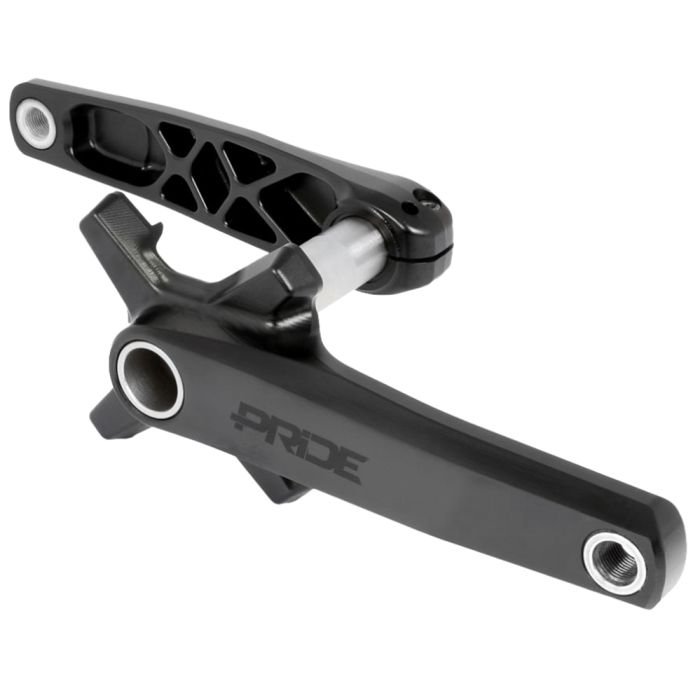
Pride Newton SX Cranks
As low as £349.98
SKU
PRDE-CRNK-NWTN
The Pride Newton SX crankset was engineered with a single goal in mind: maximize performance without compromise. Designed to meet the demands of elite racers, this crankset is the perfect blend of strength, efficiency, and innovation... Read More.....
In BMX Racing, every detail matters. From the first pedal stroke to the finish line, power, precision, and reliability make the difference between winning and losing. The Pride Newton SX crankset was engineered with a single goal in mind: maximize performance without compromise. Developed with advanced engineering and designed to meet the demands of elite racers, this crankset is the perfect blend of strength, efficiency, and innovation. Built for those who push their limits, the Newton SX delivers the responsiveness and durability needed to dominate the track.
The Newton SX crankset is the result of Finite Element Analysis (FEA), a cutting-edge engineering process that simulates real-world forces and stress distribution to refine every design detail. This ensures unmatched performance in BMX Racing, where every watt of power counts.
A crankset that maximizes power output, reduces flex, and delivers explosive performance from the start gate to the finish line. The Newton SX is forged from high-performance 7000-series aluminium alloy, ensuring strength and rigidity far beyond that of conventional cranksets.
Unlike hollow-forged cranks, which can hide internal weaknesses, the waffle-structure forging process provides better control over wall thickness and structural integrity, making the Newton SX more reliable and stable over time.
The Newton SX also features an integrated chainring bolt system, eliminating the need for separate bolts—simplifying the setup while increasing rigidity. With a Q-Factor of 168 mm, it offers the ideal stance for BMX racers, balancing stability and efficiency at every pedal stroke. Weighing in at just 738g (175 mm version), the Newton SX is among the lightest BMX crank sets on the market.
- Minimal unnecessary weight while maintaining extreme stiffness
- Reduced lateral flex for a more efficient and responsive pedalling experience
- Impact resistance in the toughest BMX conditions
- Increased stiffness for better power transfer—less flex means more energy turned into forward motion
- Enhanced durability and impact resistance—engineered to withstand high-intensity racing and hard landings
- Optimised structural stability—our waffle-structured design ensures consistent wall thickness, superior strength, and precision in manufacturing
- Fast and easy chainring swaps thanks to the integrated bolt system—no more hassle picking bolt lengths
- Increased stiffness—fewer weak points mean a more rigid drivetrain, better power transfer, and improved longevity
- Optimised Q-Factor of 168 mm, the ideal position for BMX Racing
- Perfect alignment for maximum power and stability
- Optimised pedalling position for smoother, stronger acceleration
- Crank Arms: 7000-series forged and machined aluminium
- Spindle: 24 mm – heat-treated chromoly steel
- Compatibility: BB86 - BSA 68/73 mm
- Chain line: 43.5 mm
- Q-Factor: 168 mm
- Chainring Mount (BCD): 104 mm
- Mounting Points: 4-bolt
- Weight: 738g (175 mm)
- Colour: Black
- Lead Time: 0
Write Your Own Review
Only registered users can write reviews. Please Sign in or create an account
People also bought




New Rider?
FREESTYLE VS RACING BMX BIKES?
Choosing the correct bike for your discipline is extremely important, and sometimes for those new to the sport it can be difficult to know or decide, so we’ve broken down the main differences to help you make a decision.
Freestyle bikes are designed for the skatepark, the streets or the trails. They are constructed from strong, hard wearing materials and usually feature Steel or Chromoly frames. This means that the bike can stand up to a certain amount of impacts and hard landings, but remember no bike is indestructible. For riders looking to learn tricks and stunts, then a freestyle bike is the correct choice.
Race bikes are designed specifically with the track in mind, they are nimble lightweight machines for putting down quick lap times. Typically, they are constructed from lightweight materials like aluminium and carbon fibre to keep the weight down and the rider at the front of the pack. These bikes are strong enough for smooth landings on race and pump tracks but will not take the abuse that a freestyle bike would in concrete skateparks. If you’re looking to set fast lap times or begin your competitive career on the track, a race bike is the right choice.
WHAT SIZE BIKE WOULD I NEED?
Choosing the correct size BMX bike is very important, bikes that are too large will be cumbersome and hard to manoeuvre and bikes that are too small can feel cramped and hard to keep under control.
Youth freestyle bikes are sized depending on the diameter of the wheel staring at 12” all the way through to 18”, at a 20” wheel the bike is considered an adult size. Adult freestyle bikes are sized on top tube length, a 18.5” top tube is extra small for younger teenagers who have just moved up to an adult bike, a 20” top tube is small, 20.5” a medium and anything over a 21” is considered large.
Race bikes feature 20-inch wheels on all models, but the components and frame are sized dependent on age and height. Youth race bikes start from a Micro size for very young riders and offer a range of sizes through to expert XL. Pro size and upwards are considered adult bikes and are usually offered up to a Pro XXXL or larger for very tall riders.
We recommend consulting our height charts from the link below to help you choose your perfect sized bike:
WHAT LEVEL DO I NEED?
Choosing the right level bike for your riding ability is important. Components that are not suitable for your level of riding can wear or fail much sooner than expected. Although BMX bikes can look very similar, under the surface components and materials used can vary greatly.
All our bikes are cherry picked from the very best BMX specialist brands, and all our bikes are designed specifically for use at the skatepark or on the track.
FREESTYLE BIKES
For first time riders new to the sport our entry level bikes, priced from £200-£400, are perfect, most of these are made from high tensile steel which means they are still relatively strong, but can be slightly heavier than higher end models. You might find you’ll want to upgrade to something lighter sooner than you’d think. If you are planning on using the bike in rain or bad weather, we do strongly advise choosing a model with fully sealed bearings all round.
If you are already confident on a bike and have some experience in skateparks or performing tricks and jumps then we would recommend choosing a mid-range bike, priced from £400 to £700, with a full Chromoly frame, fork, and bars. This will be lighter and stronger than an entry level model.
For an experienced person that is already capable of performing most tricks and has previously owned BMX bikes then a high-end complete bike, or full custom would be suggested to meet the demands of this rider, these bikes are priced from £700 plus.
RACE BIKES
Our range of entry level race bikes are perfect for first time racers, usually priced between £200 and £400 most of these are constructed of heavier steel rather than aluminium. These are great to get a feel for the sport but would not be able to keep up in a competitive environment.
Our mid-range race bikes are the perfect for riders who are beginning their path to competitive racing. Priced between £400 and £800 these are not quite the high-end steeds you see at national level races, but they all feature lightweight aluminium frames and are designed specifically with the racetrack in mind.
For experienced riders who are already racing confidently at a competitive level we offer a small range of high-end complete bikes. These are usually priced between £800 and £1500 and feature many aftermarket components like carbon forks, disc brakes and folding tyres. However, at this level we highly recommend building a full custom bike, usually costing between £1500 and £3000 all components can be chosen specifically with the rider in mind. For help on building a custom bike give us a call or drop us an email!
CASSETTE OR FREECOASTER
One of our most frequently asked questions in freestyle is, which rear hub do I want, a freecoaster or a cassette? Most experienced riders know their preference, but if you’re new to the sport it can be difficult to know which choice to make.
The main difference between the two is the way the bike performs when going backwards. A traditional cassette hub requires the rider to pedal in time with the rotation of the wheel while travelling backwards, while a freecoaster allows the rider to travel backwards while keeping the pedals level in the same position as riding forwards.
Although this may seem like a brilliant feature, it does come at a price! Freecoaster hubs feature a “Slack” before engagement while pedalling forward. This means that you can turn the crank a set amount (Usually an adjustable amount) before the drivetrain engages. This is referred to as the “Slack”, when riding backwards you must keep your feet positioned within the slack, if your pedals rotate too much the drivetrain will engage and your pedals will start to rotate. The smaller the slack, the harder it is to keep your pedal positioned within it while riding backwards. This means that certain tricks are harder to perform, especially those that rely on pedal pressure, for example Tire Taps.